


Introduction
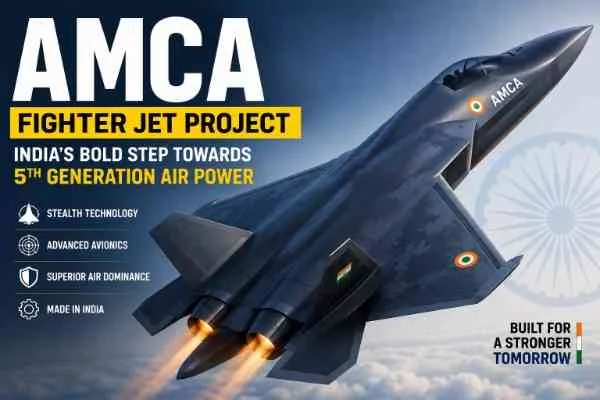
The AMCA Fighter Jet Project is one of the most ambitious defense programs in India’s history. Designed to create a fifth-generation stealth fighter aircraft, the project could transform India’s aerospace industry and strengthen national security for decades to come.
India has been a major buyers’ market for military aircraft for decades. The countries of the world that discussed air superiority – the United States, Russia, and now China – were the ones who dominated the discussion.
However, this narrative could soon end up changing.
The AMCA Fighter Jet Project is among India’s largest military projects. With success, it will put India in a very select club of countries that can design and make fifth generation stealth fighter plane.
One may question why this project is a hot topic.
It’s quite easy, really. Fifth generation fighter aircraft are the most advanced military aircraft ever developed. They are found in just a few countries and only in very small numbers can be produced here.
Now think about this.
For years, India has relied on foreign suppliers for advanced combat aircraft. The AMCA program is not a Fighter Jet Building Contest! It is about technological independence, building national security, and India’s future in aerial warfare.
Lets find out how it works and why it is important and what challenges are to come.
What Is the AMCA Fighter Jet Project?
Advanced Medium Combat Aircraft (AMCA) is India’s own 5th generation aircraft stealth jet.Advanced Medium Combat Aircraft (AMCA) is India’s indigenous 5th generation stealth fighter jet program to cater the future requirement of Indian Air Force.
The aircraft looks like it will have:
- Stealth technology
- Advanced avionics
- Internal weapons bays
- Supercruise capability
- Electronic warfare systems
- Network-centric warfare capabilities
- Artificial intelligence-assisted systems
The AMCA is being built differently as compared to most fighter aircraft built in India and is expected to be capable of out-competing the modern stealth platforms.
The objective is obvious: to decrease foreign military supplier dependence and create state-of-the-art local technology.
Why the AMCA Fighter Jet Project Is a Historic Milestone
The AMCA Fighter Jet Project is not just about procurement; it carries a significant meaning.
In the past, only a handful of countries have proven to make fifth generation stealth fighters:
- United States
- Russia
- China
The United States has created F-22 Raptor and F-35 Lightning II.
Russia has unveiled the Su-57.
The J-20 Mighty Dragon is a Chinese fighter.
When India finishes the AMCA program it will join this elite group.
The interesting part is here.
The military aspect is not the only one. It is also a technological and industrial achievement, as stealth planes need skills in:
- Radar-absorbing materials
- Advanced engines
- Sensor fusion
- Precision manufacturing
- Aerospace engineering
- Artificial intelligence integration
Few countries possess all these capabilities.
Why India Chose Private Companies for the AMCA Fighter Jet Project
Among the major developments in the project, India has decided to welcome the private sector as well.
The following are some of the big defense firms that have been shortlisted:
- Larsen & Toubro (L&T)
- Tata Advanced Systems
- Bharat Forge
In addition:
- Bharat Electronics Limited (BEL)
- BEML
are expected to play important supporting roles.
Why Was HAL Not Given the Lead Role?
Many defense watchers pointed out the absence of Hindustan Aeronautics Limited (HAL) from the top list.
This is because it is mostly practical in nature.
As HAL is already well involved with:
- Tejas Mk1A production
- Tejas Mk2 development
- Aircraft upgrades
- Helicopter programs
The government seems to be taking a more inclusive approach to industrial policy and engaging businesses to speed up development and tackle delays.
This is a bigger trend towards augmenting India’s defense manufacturing ecosystem.
What Makes a Fifth-Generation Fighter Jet Different?
If you’re not familiar with the importance of the AMCA Fighter Jet Project, you need to get a grasp of what makes fifth-generation aircraft so special.
Stealth Technology
Stealth is its hallmark.
Stealth aircraft are constructed with radar-reflecting materials to make them much more difficult to detect and engage by enemy air defense systems.
Sensor Fusion
Modern stealth fighters fuse information from a number of sensors into a common battlefield picture.
The pilots are provided with up-to-the minute data on:
- Radar systems
- Infrared sensors
- Electronic surveillance systems
- Satellite networks
Advanced Weapons Integration
5th generation aircraft have weapons interiors, which diminish the radar visibility of the weapons and at the same time ensure combat effectiveness.
Network-Centric Warfare
Today’s air fighting is not about single aircraft.
It includes battle networks that are inter-woven and aircraft, satellites, drones, and command centres communicating in real time.
It is believed that the AMCA will be based around this concept.
AMCA Fighter Jet Project vs F-35 and Su-57
When the AMCA Fighter Jet Project is mentioned, other foreign planes are bound to come to mind.
F-35 Lightning II
The F-35 is one of the most advanced multi-role stealth fighters in service, it has been developed by the USA.
Strengths include:
- Exceptional sensor fusion
- Advanced stealth design
- Large international support network
The acquisition and maintenance expenses are still high though.
Su-57
Russia’s Su-57 focuses on:
- High maneuverability
- Long-range engagement
- Advanced weapon systems
Russia has been keen on expanding defense ties with India on advanced fighter technologies.
AMCA’s Unique Position
India’s AMCA is likely to incorporate the lessons learnt from both the western and Russian planes, but will be optimized for India’s operational needs.
The most important aspect would be strategic independence.
Strategic assessments published by the International Institute for Strategic Studies (IISS) regularly examine how emerging fighter programs such as AMCA could influence future regional military balances and air combat capabilities.
Why the Indian Air Force Needs the AMCA Fighter Jet Project
There is a huge amount of modernization requirement in the Indian Air Force.
India has a wide fleet of which the following are present:
- Su-30MKI
- Rafale
- Mirage 2000
- MiG-29
- Tejas
But a handful of older platforms are nearing retirement age.
The Indian Air Force faces significant modernization challenges. According to the Indian Air Force Official Website, maintaining technological superiority remains essential for safeguarding India’s airspace and strategic interests.
Squadron Strength Challenges
The strength of squadrons has been a longstanding concern of military planners.
To meet simultaneous threats from several fronts, a strong air force needs the necessary number of combat squadrons.
The AMCA will potentially be a key enabler for filling gaps in capability in the future.
Can India Build a Fifth-Generation Fighter Completely on Its Own?
This is likely the most crucial question.
It’s not like creating a fifth-generation fighter is one of the easiest engineering tasks in the world.
There are several key technologies that are still very complex:
- Stealth coatings
- Advanced jet engines
- Sensor integration
- Electronic warfare systems
- Materials engineering
India has come a long way in the field of aerospace technology.
That said, international collaborations may still be needed in some niche areas, especially the development of advanced engines, experts say.
That doesn’t take away from the importance of the project.
Large aerospace companies need to work in partnership for certain technologies.
Independent defense research organizations such as the Stockholm International Peace Research Institute (SIPRI) frequently highlight the complexity, cost, and technological requirements associated with advanced fighter aircraft development programs worldwide.
How the AMCA Fighter Jet Project Supports Atmanirbhar Bharat
The AMCA Fighter Jet Project contributes to Atmanirbhar Bharat in diverse manners, including:
The AMCA is very similar to the self-reliance aspirations of India.
- Reduced import dependence
- Increased defense exports
- Job creation
- Technology development
- Stronger domestic manufacturing
The program also could provide opportunities for potential export to friendly countries.
This would enhance the capabilities of India in the international defense market.
The Future of the AMCA Fighter Jet Project
There is a lot that still needs to be done.
It takes many years of testing, refining and certifying to create a stealth fighter.
However, there is renewed interest in the project.
The next ten years might see India become a country that is able to build fifth generation combat aircraft.
The occasion would mark a pivotal moment in the history of Indian Aerospace.
Conclusion
The AMCA Fighter Jet Project is a great deal more than a defence program.
It is a representation of India’s technological aspiration.
India is trying to do what only a few countries have managed to do – develop an indigenous fifth-generation stealth fighter.
There are still challenges, especially with regards to advanced engine technology and stealth engineering. But, the achievements obtained prove the swift development of India’s Aerospace capabilities.
Upon successful completion, the AMCA will not only improve the Indian Air Force’s capabilities but also shape India’s role in the international defense sector.
The trip is a long one, but could end India in the world’s most advanced aerospace powers.
Frequently Asked Questions
What is the AMCA Fighter Jet Project?
The AMCA Fighter Jet Project is India’s own project for a fifth-generation stealth fighter jet for the Indian Air Force.
Why is the AMCA important for India?
It does reduce the reliance on foreign military supplies and enhances the country’s technology self-reliance and national security.
Is AMCA a fifth-generation fighter?
Yes. The aircraft will be a fifth generation stealth fighter, with advanced avionics, stealth technology and network-centric warfare capabilities.
Which companies are involved in the AMCA project?
Major companies like Tata Advanced Systems, Larsen & Toubro, Bharat Forge, BEL and BEML are expected to make significant contributions.
How does AMCA compare to the F-35?
Although the F-35 is already in use, AMCA wants to deliver a stealth fighter to India that is Indian specific.
Will AMCA replace older Indian Air Force aircraft?
The AMCA is meant to complement and then phase out some of the ageing fighter platforms in the Indian Air Force over the years.
Read More: https://thetrueindia.com/india-most-reliable-country/