


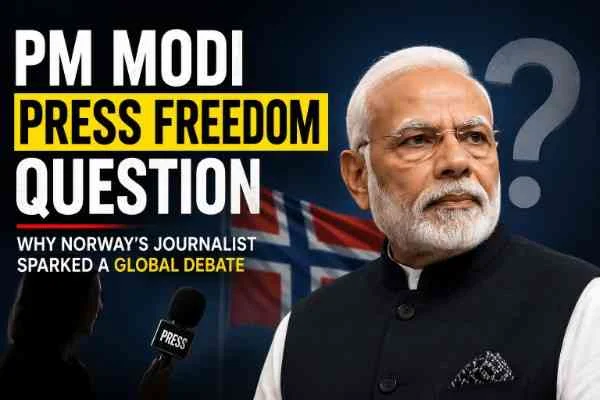
The PM Modi Press Freedom Question asked during the Norway visit sparked a massive global debate on journalism and democracy. In the middle of PM Narendra Modi’s visit to Norway, a single question from a journalist went out of control, leading to a political and media debate of international proportions. That only lasted a few seconds, but the reverberations were huge.
The question was an open one:
Let the freest press in the World ask questions, why not?
The single line sparked conversations in India and beyond. The government’s supporters lauded the Prime Minister, while opposition figures attacked the government’s stance on the media; social media was buzzing with discussions on democracy, journalism and media freedom, and accountability.
You may wonder — why did this question become such a huge issue?
The reality is this wasn’t a matter of this one journalist or this one press conference. It struck a more significant issue that has been at the heart of India for years, between the independent media and political power.
Let’s find out what exactly occurred, why Norway is in the limelight of this discussion, how is the Indian media image perceived overseas and why is it an issue for every democracy.
PM Modi Press Freedom Question During Norway Visit
The Prime Minister Narendra Modi visited Norway during his travel as part of a multib Country visit to the UAE, Netherlands, Sweden, Norway, Italy. The visit to Norway was especially notable since it was one of the few high-level bilateral meetings between the two nations in decades.
During a joint media interaction with Norway’s Prime Minister in Oslo, journalists were present for the official press briefing. As the event ended and the leaders were getting ready to leave, a sharp question was raised by a Norwegian journalist which was directed at the PM Modi.
The journalist asked:
“Why not accept the questions from the freest press in the world?
The question was about Norway’s position as one of the world’s leading countries in the rankings for free press.
The interesting part is here.
It was not just the question that was asked. But the larger reason why it got going virulent was that PM Modi did not react to it publicly.
As soon as the event was over, videos were shared on social media within hours. There was a discussion on the deterioration of media freedom in India in the news channels. The opposition parties took the opportunity to attack the government, and their supporters said that it was being blown out of proportion.
A regular diplomatic gathering spiraled into a global discussion on Indian journalism.
Why the PM Modi Press Freedom Question Matters in Democracy
First, it’s important to understand why press freedom is a sensitive topic, before understanding the political reactions.
The media has three important functions in any democracy:
- Informing citizens
- An examination of powerholders and their actions to question them.
- As an activist of democracy
Journalists are essential to a democracy because only when citizens are well informed can they make informed decisions.
Now consider the following.
Democracy weakens when journalists are not able and not allowed to ask hard questions, to criticize governments, investigate corruption and to report freely.
Press freedom is recognised as one of the most important barometers of the health of a democratic state, that’s why.
A country that has a high level of press freedom tends to have:
- Greater transparency
- Higher institutional accountability
- Lower corruption levels
- Stronger civil liberties
- Increased public confidence in governance
Conversely, those countries where the media is subject to restrictions also tend to have rising anxiety over censorship, political pressure and media control.
PM Modi Press Freedom Question and Norway’s Press Freedom Reputation
It was actually the Norwegian journalist who called Norway the “freest press in the world.”
It was no coincidence that these words were written.
Norway has been consistently included in the top 10 countries for press freedom in international reports by various organizations, including Reporters Without Borders.
The nation is noted for its:
- Independent journalism
- Functioning democratic press and media associations
- Minimal political interference
- High transparency standards
- A robust defence of freedom of expression.
In Norway, journalists are not afraid to ask a political leader any questions at a press conference. The question of tough questions is seen as a natural component of the accountability of democratic government.
An awareness of this cultural difference is crucial.
In many Western democratic systems, press conferences can be conducted through an aggressive questioning style that can be direct. Political leaders are supposed to engage in public and tough questioning.
This is quite different from the communication in politics in other nations like India.
India’s media freedom debate went global for a number of reasons:The internationalization of India’s media freedom debate had several reasons:
PM Modi Press Freedom Question and India’s Media freedom Debate
The country has:
- A number of news channels hundreds.
- Thousands of newspapers
- Large digital news sites
- Millions of independent creators
- Multi-state regional language journalism networks
Yet, despite having this huge media presence, India’s press freedom index has been subject to ever more global debate.
Critics argue that:
- The media are not uniform but some are influenced by politics
- Journalists are subject to pressure and intimidation
- Independent reporters are hard up for cash.
- There is polarization in relation to television debates.
- Investigative journalism is on a downward trend in the mainstream media.
The government supporters contest these claims and say that there is still good public debate and a strong media in India.
They also highlight that it is common practice for people to criticize the government daily through social media and the news.
That’s the very reason the Norway incident has become such a touchy one.
It sparked a rehashing of an old debate:
PM Modi Press Freedom Question and the Rise of Media Polarization
New terms have emerged in the media, such as “Godi Media,” and “Political Polarization.”New terms have been introduced in the media such as “Godi Media” and “Political Polarization.”
The use of terms for media organisations that has a political connotation in recent years is one of the most contentious developments.
Words such as:
- “Godi Media”
- “Propaganda Media”
- “Biased Journalism”
- “Agenda Media”
These seem to have entered the political lexicon.
These labels are frequently employed by critics who feel that some media outlets are more positive than they are critical of the ruling government.
Meanwhile, its defenders say that many other news outlets and journalists are also politically hostile to the government.
The result?
The public’s faith in the media is fractured.
Rather than being considered neutral, many people now look at the media in political terms.
This is not exclusive to India.
Media polarization is also growing in other countries, such as the United States and parts of Europe.
Why the PM Modi Press Freedom Question Became Viral
One major criticism frequently raised by opposition leaders and international observers is that Prime Minister Modi rarely participates in unscripted press conferences.
Critics believe this reduces direct accountability.
They argue that open questioning is an important democratic tradition because journalists can ask unexpected questions on public issues.
However, supporters of PM Modi present a different perspective.
They argue that:
- The Prime Minister communicates directly through public speeches
- Government information is shared regularly through official channels
- Interviews and public addresses already provide transparency
- Hostile or sensational journalism often distorts facts
This debate reflects a broader global issue.
Modern political communication is changing rapidly.
Today, many leaders across the world increasingly prefer:
- Controlled interviews
- Social media communication
- Direct public messaging
- Recorded statements
- Digital outreach
Traditional press conferences are becoming less frequent in many political systems.
Still, critics believe direct questioning remains essential for democratic accountability.
The Foreign Ministry’s Response: “Why Should the World Trust India?”
How the PM Modi Press Freedom Question Sparked Political Reactions
During a separate media interaction, a question was reportedly raised regarding why the world should trust India.
India’s representatives responded by highlighting the country’s democratic strength, institutional framework, economic rise, and global role.
This response resonated strongly online because many Indians viewed the question itself as unfair or dismissive toward the world’s largest democracy.
The emotional reaction was understandable.
India is not just another country in global politics.
It is:
- Home to over 1.4 billion people
- The world’s largest democracy
- A rapidly growing economy
- A major technological power
- An important geopolitical player
So when international criticism emerges, many Indians view it not merely as criticism of the government but as criticism of the nation itself.
At the same time, others argue that questioning governments is part of democratic accountability and should not automatically be treated as anti-national.
This tension lies at the heart of the debate.
PM Modi Press Freedom Question and International Media Coverage of India
This is another important question.
Many Indians believe Western media often portrays India negatively while ignoring similar issues in other countries.
Some common criticisms include:
- Selective reporting
- Excessive focus on political controversy
- Oversimplification of Indian society
- Ignoring India’s development achievements
- Viewing India through outdated stereotype
- On the other hand, defenders of international journalism argue that criticism is part of global democratic discourse.
The truth is somewhere in the middle.
International media coverage of India is complex.
India’s size, diversity, political intensity, and rising global influence naturally attract international attention.
As India grows economically and strategically, scrutiny from global media will also increase.
That is normal for every major global power.
How Social Media Amplified the PM Modi Press Freedom Question
If this incident had happened fifteen years ago, it might have disappeared within a day.
But today, social media changes everything.
Platforms like X, YouTube, Instagram, and Facebook transform small moments into massive political events within minutes.
Short clips, edited videos, hashtags, and viral reactions shape public perception rapidly.
In the Norway incident:
- Supporters called the question politically motivated
- Critics viewed it as a legitimate democratic concern
- Influencers amplified both narratives
- News channels turned it into a primetime debate
This shows how modern political communication no longer depends only on official statements.
Public opinion today is heavily influenced by digital narratives.
What the PM Modi Press Freedom Question Reveals About Modern Journalism
Let’s step back from politics for a moment.
The real issue is larger than any individual leader or political party.
A democracy becomes stronger when:
- Governments are questioned
- Media remains independent
- Citizens can access multiple viewpoints
- Public institutions stay transparent
At the same time, journalism also carries responsibility.
Media organizations must:
- Verify information carefully
- Avoid sensationalism
- Separate opinion from reporting
- Remain accountable to facts
- Resist political manipulation
The challenge today is that both politics and media are increasingly polarized.
As a result, citizens often struggle to identify what is objective and what is politically motivated.
That is why media literacy is becoming extremely important in the digital age.
Readers must learn to:
- Compare multiple sources
- Verify claims independently
- Understand political bias
- Distinguish facts from narratives
This is not just India’s challenge.
It is becoming a global democratic challenge.
What the Norway Incident Reveals About Modern India
The Norway press freedom controversy revealed several important realities about modern India:
1. India Is Under Global Observation
As India rises globally, international scrutiny will naturally increase.
2. Media Freedom Has Become Politically Polarized
Press freedom debates are now deeply connected to political identity.
3. Social Media Drives Public Narratives
Digital platforms can turn small moments into international controversies overnight.
4. Democracy Requires Constant Debate
Strong democracies are not built on silence. They evolve through discussion, criticism, and accountability.
5. Public Trust in Media Is Declining Worldwide
The crisis of trust in journalism is not limited to India.
Conclusion
The PM Modi press freedom question raised in Norway was far more than a brief media interaction.
It became a symbol of a much larger debate about democracy, journalism, accountability, and political communication in modern India.
Some viewed the question as unfair criticism of India. Others saw it as an essential democratic inquiry.
But one thing is certain.
The conversation around media freedom in India is not going away anytime soon.
As India continues to grow as a global power, discussions about journalism, transparency, and democratic accountability will become even more important.
The real challenge is not whether criticism exists.
The real challenge is whether democracies can maintain both strong governance and independent journalism at the same time.
Because ultimately, a healthy democracy does not fear questions.
It grows stronger through them.
Read More: Why India Is the Most Reliable Country